
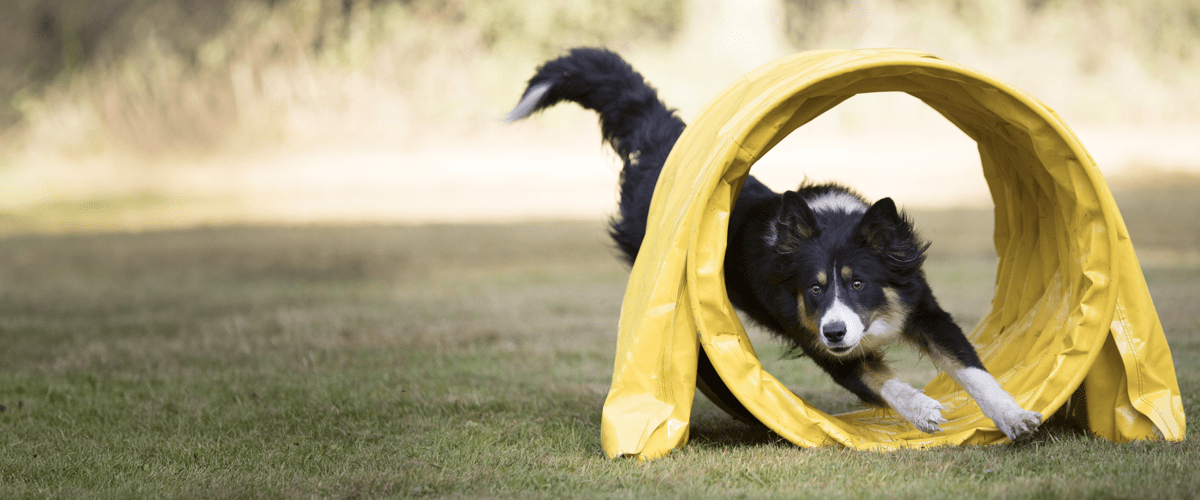

August 11, 2026 — We all know exercise is important for our dogs, but how much is enough? What type is best? Do dogs that participate in sports from an early age have slower mental declines? What about dogs that prefer the couch to the agility course? Can regular play still support their cognitive health? A team led by Dr. Péter Pongrácz at Eötvös Loránd University in Hungary set out to try to answer these questions.
Highlights
— Researchers studied 858 senior dogs to explore factors linked to canine cognitive decline (CCD).
— Dogs with a history of sports participation showed lower CCD scores.
— Regular interactive activities with owners, including fetch and tug-of-war, were associated with better cognitive health.
— Benefits were seen even in dogs that were not competitive athletes.
— Researchers suggest that lifelong engagement and activity may help dogs stay mentally sharp as they age.
“We wanted to know whether sports engagement or being a ‘couch potato’ would affect cognitive aging in dogs. We wanted to know if doing some activity could preserve cognitive capacity. This is something very approachable for the everyday dog owner,” said Dr. Pongrácz.
The team recently published a paper that found that dogs that engaged in a lifetime sports career or in joint activities with their owners had a lower chance of developing canine cognitive decline (CCD) than dogs that did not.
In this study, 858 dogs and their owners were recruited by Dr. Pongrácz and team. There were 206 mixed-breed dogs and 652 purebred dogs. Of these purebreds, 206 were characterized as independent working breeds (think beagle), 394 were from cooperative breeds (think border collie) and 50 were toy breeds.
The team began by sending out questionnaires to the owner participants. They asked questions about:
The team then analyzed the data.
Not surprisingly, they found that a dog’s age had a significant association with CCD. They didn’t find an association with some factors such as height or weight with CCD.
What was most surprising to the team, and most important for dog owners, was that any joint activity between owners and dogs was significantly associated with lower CCD scores, independent of a dog’s previous sporting history.
Joint activities are playtime. Throwing a ball, playing tug-of-war – the key point is that the activities must be interactive. Simply taking a dog for a walk, while important, did not have as big an effect on lowering CCD scores. The team found that engaging in a joint activity at least once per week was helpful in keeping dogs mentally sharp.
“I think this is very good news. This means you don’t need to have a dog who is an athletic superstar to help them avoid CCD,” added Dr. Pongrácz. “It’s good news for owners with toy breed dogs, or dogs whose conformation, like a French bulldog, might prevent them from taking part in activities like agility. Simply playing games with them a few times a week can have a profound effect on the development of CCD. Since toy breeds often live long lives, it is especially important for these dogs. I think this is a nice message!”
The team also noted that it didn’t matter if dogs were classified as independent or cooperative breeds when it came to CCD. Sports activity and interactions with owners are still important.
Dr. Pongracz emphasized that joint activities or sporting events need to start when dogs are young. Trying to add in activity when a dog is older would probably not have the same effect.
So grab a ball, Frisbee, rope toy, or favorite training treats and spend some time playing with your dog. According to this research, those moments of fun may do more than strengthen your bond. They could also help support your dog's cognitive health as the years go by.
Frequently Asked Questions
What is canine cognitive decline (CCD)?
Can playing with my dog help prevent dementia?
What kinds of activities were linked to better brain health?
Does my dog need to compete in sports?
Are some breeds more likely to benefit?
When should dogs start participating in activities?